What if your home robot finishes the job... but breaks your kitchen in the process?
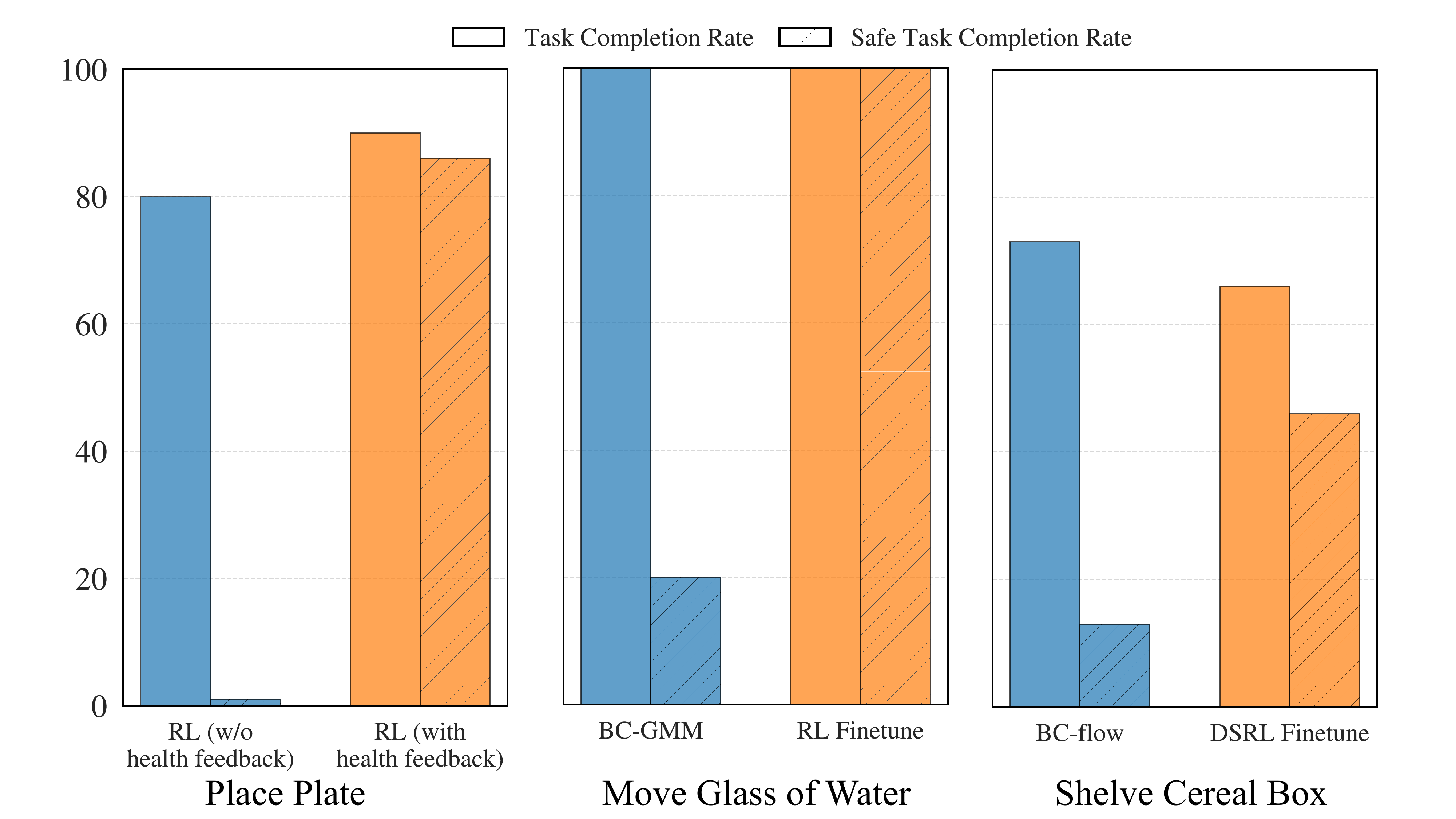
Robots are getting better at manipulating everyday objects, but task success alone is not enough. A robot that picks up an egg while cracking it, or pours water while spilling half of it, is not ready for real homes. The missing piece is safety. And today's simulators barely measure it.
OopsieVerse tackles this problem head on. It introduces a unified, damage-aware simulation framework for household manipulation, where harm is no longer invisible. Instead of only rewarding task completion, OopsieVerse augments the standard decision-making setup with explicit damage signals, penalties, and user-defined safety preferences.
At the heart of the system is DamageSim, a simulator-agnostic layer that converts physical signals like contact forces, temperature changes, and liquid interactions into measurable mechanical, thermal, or fluid damage. Paired with a benchmark suite of household tasks, OopsieVerse cleanly separates "did the robot succeed?" from "did it do so safely?"
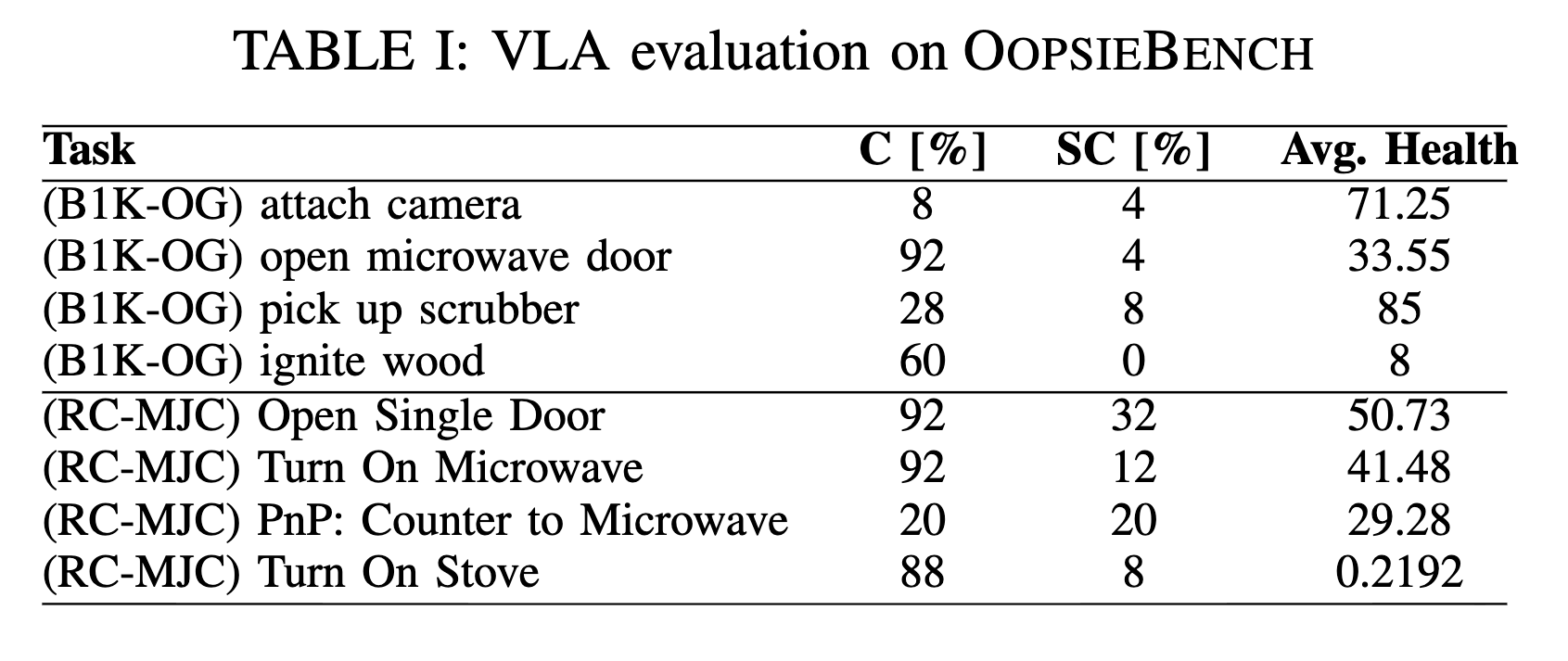
Integrated into both BEHAVIOR-1K (Omniverse) and RoboCasa (MuJoCo), OopsieVerse supports 1) safer data collection, 2) damage-aware imitation and 3) reinforcement learning, 4) safety benchmarking of Vision-Language-Action policies and more, for improved sim-to-real transfer of safer behaviors.
In short, OopsieVerse shifts the focus from performance alone to safer performance, helping move household robots closer to damage-free deployment in the real world.
DamageSim is our simulator-agnostic plugin that makes physical safety measurable by tracking object-centric “health.” It monitors simulator signals—such as contact forces, temperature, and liquid exposure—and converts them into mechanical (e.g., impact or compression), thermal, and fluid damage, which can be used as observations, rewards, or termination conditions. We instantiate it in RoboCasa (MuJoCo) and BEHAVIOR-1K (Omniverse) showcasing its consistency across simulators.
Mechanical Damage
Thermal Damage
Fluid Damage
Damage-Augmented POMDP Implementation with DamageSim. Conceptually, our DamageSim plugin (blue) extends an existing POMDP in simulation (green, dotted arrow to agent) by augmenting the state with health. The health state can in turn influence the observations and rewards, and/or provide access to new damage-aware terminal states. DamageSim implements the health state to augment the original POMDP state into a Damage Aware state (sDA ∈ SDA = S × Sh) as a per-object physical property, updated at every timestep by a set of damage evaluator models (DEM) that compute mechanical, thermal, and fluid damage (dDEM) from simulator state and interactions, reducing per-entity health accordingly. The augmented POMDP provided by DamageSim approximates better the conditions of the real-world task.
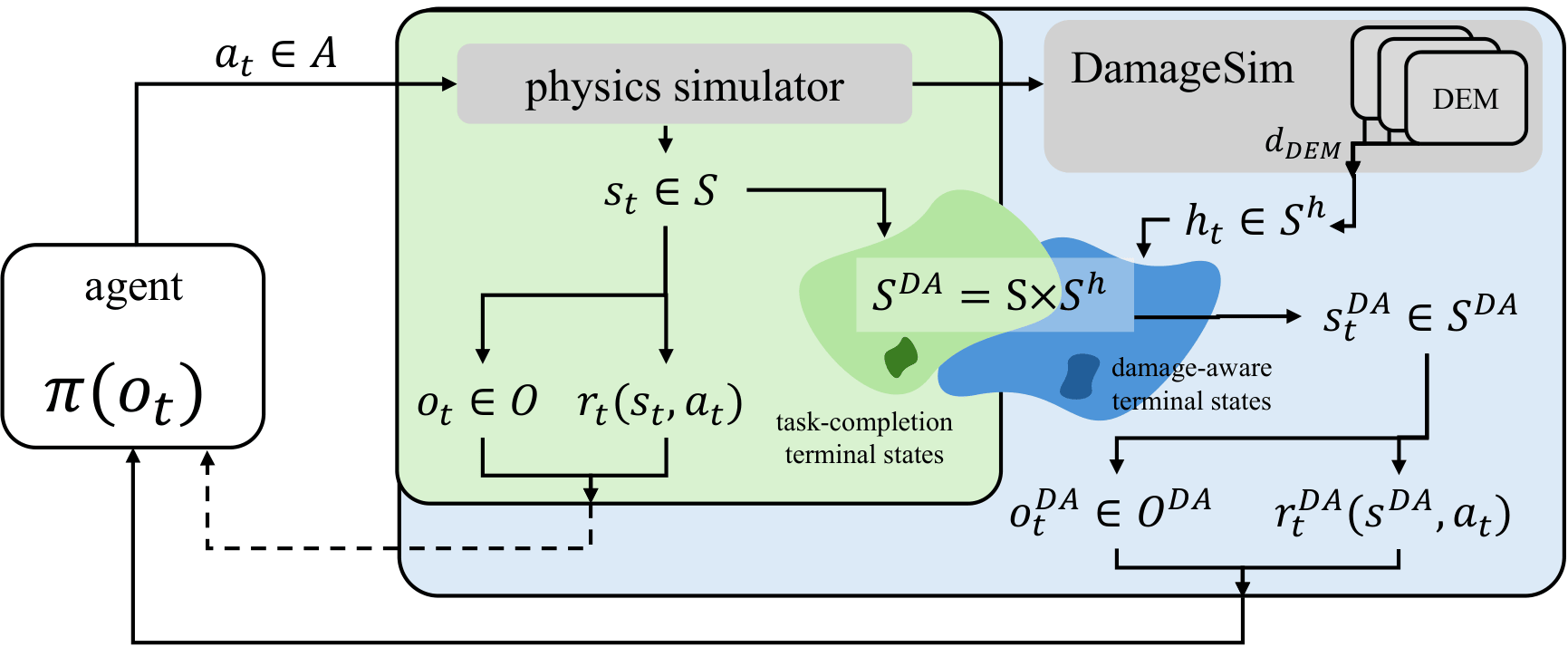
DamageSim is simulator-agnostic. we instantiate it in BEHAVIOR-1k (Nvidia Omniverse) and RoboCasa (MuJoCo) to demonstrate consistent safety measurement across different physics backends.
RoboCasa
BEHAVIOR-1k
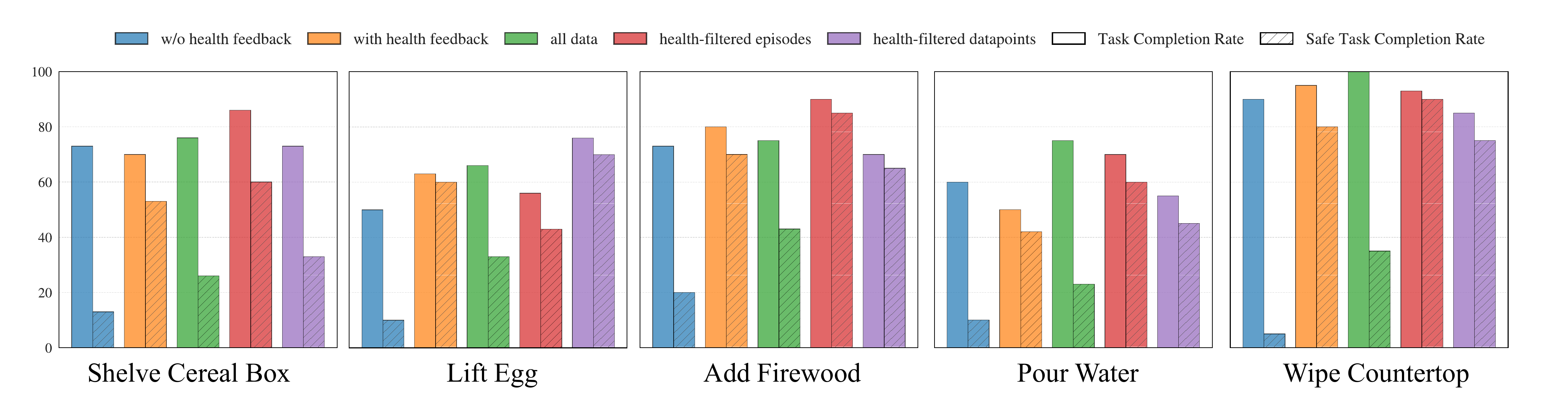
OopsieBench is a suite of 32 household tasks in total (15 tasks shown in the grid below; hover a tile to see its name). The suite is designed to (i) expose policies to realistic, physically damaging failure modes in household manipulation, and (ii) make safety measurable by contrasting easy but risky strategies with safer ones that require more careful interaction (e.g., gentler contact, safer approaches, or avoiding hazards). The benchmark spans diverse scenes, objects, and damage modalities, is cross-platform (BEHAVIOR-1k and RoboCasa), and includes a dataset of safe and unsafe human teleop demonstrations for five tasks.
Click a tile to enlarge.
Pour Glass
Add Firewood
Lift Egg
Shelve Item
Wipe Countertop
Attach Camera
Open Microwave Door
Pick up Scrubber
Ignite Wood
Open Single Door
Turn on Microwave
Counter to Microwave
Turn on Stove
Pour Water (Safe + Unsafe Data)
Pour Water (Safety-filtered Data)
Shelve Cereal Box (Safe + Unsafe Data)
Shelve Cereal Box (Safety-filtered Data)